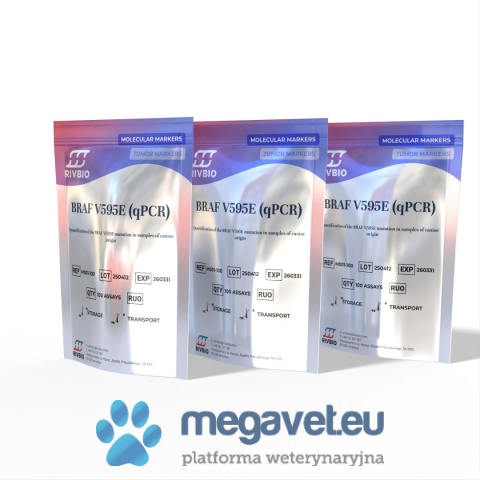
ProductBRAF V595E(qPCR)is used to quantify copies of the geneBRAFwith mutationV595Ein the total DNA obtained from the dog’s urine or extracellular DNA obtained from the dog’s blood.
Product characteristics
Package size: 100 reactions
Reaction: duplex (FAM: geneBRAFV595E, HEX: internal control)
Internal control: exogenous/endogenous
Designation: qualitative/quantity
Test genome: dog (Canis familiaris)
Kit components:
- Reaction mixture: contains DNA polymerase, probes and starters and other components of the qPCR reaction;
- Set of calibrators to produce a reference curve;
- Negative control;
- Water PCR-grade;
Application of the product
ProductBRAF V595E(qPCR)is designed for gene V595E mutation analysisBRAF, coded for serine/treonin protein kinase B-Raf. The presence of this mutation has been reported in more than 80% of cases of transient cell carcinoma.transnational cell carcinoma(TCC) in dogs. At DNA level, mutation involves converting thymidine nucleotide (T) to adenine nucleotide (A).
The product can be used to detect cancer cells in the test material in the form of urine, biopsy and blood samples. The set is quantitative: it is used to determine the percentage of cells carrying a mutated copy of the geneBRAFin relation to the total cell pool present in the test material. In the case of blood samples, the analysis is based on the determination of the proportion of DNA molecules released from circulating tumour cells (ctDNA) present throughout the pool of so-called extracellular DNA molecules (circulation cell-free DNAs, cfDNA).
BRAF V595E mutation determination principle
ProductBRAF V595E(qPCR)is based on quantitative measurement of the number of copies of the geneBRAFcarrying mutation V595E and the number of copies of the geneB2M. Number of copies of the mutant version of the geneBRAFreflects the number of tumour cells present in the test material. The number of copies of the B2M gene corresponds to the total number of dog cells present in the test material. The set contains two pairs of starters. One pair of starters multiply the mutated version of the geneBRAF. The resulting PCR product is detected using the Taqman probe labelled with FAM dye. The second pair of starters multiply a fragment of the geneB2M. The resulting PCR is detected using the HEX dyed probe.
Quantitative determination of copies of detected DNA fragments is possible through a standard curve based on the calibrations attached to the set. To quantify the percentage of cancer cells, a properly constructed spreadsheet supplied with the set should be used. The presence of cancer is indicated by the presence of cancer cells above 0.5% (based on Tagawa M., "Quantitative analysis of the BRAF V595E mutation in plasma cell-free DNA from dogs with urothelial carcinoma", 2020, PLoS One;15(4):e0232365). The value above 0.3% is significantly higher than background level (p-value < 0.001).


![Antigen test Giardia 10 pieces per package [GWV]](/images/megavet/19000-20000/Test-FeLV-AgFIV-Ab-10-sztuk-w-opakowaniu-GWV_%5B19328%5D_320.jpg)
![CPV/CCV antigen test 10 pieces per package [GWV]](/images/megavet/19000-20000/Paski-do-analizatora-moczu-InSight-MS-2-VET-50-szt-op-GWV_%5B19312%5D_320.jpg)
![CPV/CCV/Giardia Antigen Test (3DX) 10pcs per package [GWV]](/images/megavet/19000-20000/Test-antygenowy-CPVCCV-10-sztuk-w-opakowaniu-GWV_%5B19316%5D_320.jpg)
![Diagnostic tests for blood group for cats 5 pieces per package [GWV]](/images/megavet/19000-20000/Test-FeLV-AgFIV-AbFCoV-3-10-sztuk-w-opakowaniu-GWV_%5B19335%5D_320.jpg)
![Diagnostic tests for FIP peritonitis in cats [GWV]](/images/megavet/21000-22000/Test-antygenowy-FCVFHV-10-sztuk-w-opakowaniu-GWV_%5B21258%5D_320.jpg)
![E.canis/Anaplasma/B.gibsoni antibody test [GWV]](/images/megavet/21000-22000/Test-antygenowy-CPV-10-sztuk-w-opakowaniu-GWV_%5B21254%5D_320.jpg)
![FCV/FHV antigen test 10 pieces per pack [GWV]](/images/megavet/21000-22000/Test-antygenowy-CPV-10-sztuk-w-opakowaniu-GWV_%5B21253%5D_320.jpg)
![FeLV Ag/FIV Ab Test 10pcs per pack [GWV]](/images/megavet/19000-20000/Test-antygenowy-CPVCCVGiardia-3D-10-sztuk-w-opakowaniu-GWV_%5B19320%5D_320.jpg)
![FeLV Ag/FIV Ab/FCoV Test (3X) 10 pieces per pack [GWV]](/images/megavet/20000-21000/Test-antygenowy-Giardia-10-sztuk-w-opakowaniu-GWV_%5B20023%5D_320.jpg)
![Fluorescein tear test - strips 100 pcs/pack [GWV]](/images/megavet/20000-21000/Test-lzowy-fluoresceinowy-100-szt-GWV_%5B20026%5D_320.jpg)
![InSight Blood Urea Tests [GWV]](/images/megavet/19000-20000/Testy-diagnostyczne-na-grupe-krwi-dla-kotow-5-sztuk-w-opakowaniu-GWV_%5B19339%5D_320.jpg)
![InSight MS-2 VET urine analyzer strips, 50 pcs/pack [GWV]](/images/megavet/19000-20000/Paski-do-analizatora-moczu-InSight-MS-2-VET-50-szt-op-GWV_%5B19860%5D_320.jpg)
![Lacrimal test lysamine green - strips 100 pcs/op. [GWV]](/images/megavet/19000-20000/Test-lzowy-roz-bengalski-paski-100-sztop-GWV_%5B19289%5D_320.jpg)

![EasyNAT® system, 4-module, PCR analyser [CRT]](/images/megavet/24000-25000/Analizator-amoniaku-paskowy-PocketChem-BA-PA-4140-CRT_%5B24416%5D_320.jpg)
![BIOCHEMICAL CENTRIFUGE LC-04P [MEO]](/images/megavet/18000-19000/WIROWKA-BIOCHEMICZNA-LC-04C-MEO_%5B18317%5D_320.jpg)
![Freeman animal catch net - telescopic [GWV]](/images/megavet/23000-24000/Siatka-poskramiajaca-rzutka-GWV_%5B23435%5D_320.jpg)