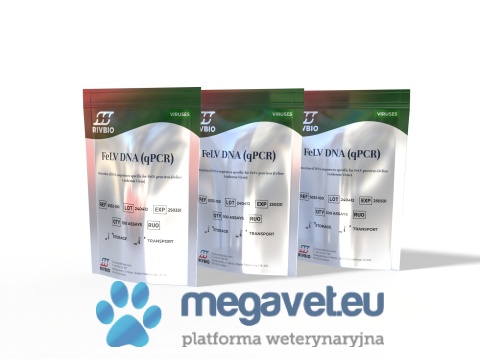
ProductFeLVDNA (qPCR)is used to determine sequences characteristic of Feline Leukaemia Virus (FeLV) provirus in DNA preparations obtained from biological material taken from the cat.
Product characteristics
Package size:100 reactions
Reaction:duplex (FAM: FeLV, HEX: internal control)
Internal control:exogenous/endogenous
Designation: qualitative/quantitative
Components of the set:
- Reaction mixture: contains DNA polymerase, probes and starters and other components of the qPCR reaction;
- Positive control;
- Negative control;
- PCR-grade water
Description of FeLV pathogen
RetrovirusFeLV(Feline Leukaemia Virus, feline leukaemia virus) causing one of the most common infectious diseases in cats. Feline leukaemia is a disease affecting several percentages of domestic cats (in Europe up to 8.8% of individuals) and some species of wild cats (e.g. Iberian lynx), affecting the length and quality of life of cats. It causes symptoms from anorexia, anemia, gingivitis to lower immunity, cancer and death.
There are four subtypes of the virus: FeLV-A, FeLV-B, FeLV-C and FeLV-T giving different clinical images of the disease. The transmission of the virus is carried out by contacting the animal with secretions or blood of the affected individual. In some infected cats, the disease does not develop progressively, but the virus remains hidden in the body (regressive infection).
Cat's leukemia virus belongs to the genusGammaretrovirus. It is a single RNA virus (+)ssRNA-RT that undergoes a two-strand DNA stage (provirus stage) during the life cycle. FeLV is built of a shell, capsid and a protein-nuclein complex containing two copies of single-strand RNA. Its genome contains three genes: gag (coded capsid), pol (coded reverse transcriptase and integrase) and env (coded glycoprotein). ProductFeLVDNA (qPCR)is designed to detect the genetic material of FeLV virus in the provirus stage, or DNA molecules resulting from reverse transcription.


![Antigen test Giardia 10 pieces per package [GWV]](/images/megavet/19000-20000/Test-FeLV-AgFIV-Ab-10-sztuk-w-opakowaniu-GWV_%5B19328%5D_320.jpg)
![CPV/CCV antigen test 10 pieces per package [GWV]](/images/megavet/19000-20000/Paski-do-analizatora-moczu-InSight-MS-2-VET-50-szt-op-GWV_%5B19312%5D_320.jpg)
![CPV/CCV/Giardia Antigen Test (3DX) 10pcs per package [GWV]](/images/megavet/19000-20000/Test-antygenowy-CPVCCV-10-sztuk-w-opakowaniu-GWV_%5B19316%5D_320.jpg)
![Diagnostic tests for blood group for cats 5 pieces per package [GWV]](/images/megavet/19000-20000/Test-FeLV-AgFIV-AbFCoV-3-10-sztuk-w-opakowaniu-GWV_%5B19335%5D_320.jpg)
![Diagnostic tests for FIP peritonitis in cats [GWV]](/images/megavet/21000-22000/Test-antygenowy-FCVFHV-10-sztuk-w-opakowaniu-GWV_%5B21258%5D_320.jpg)
![E.canis/Anaplasma/B.gibsoni antibody test [GWV]](/images/megavet/21000-22000/Test-antygenowy-CPV-10-sztuk-w-opakowaniu-GWV_%5B21254%5D_320.jpg)
![FCV/FHV antigen test 10 pieces per pack [GWV]](/images/megavet/21000-22000/Test-antygenowy-CPV-10-sztuk-w-opakowaniu-GWV_%5B21253%5D_320.jpg)
![FeLV Ag/FIV Ab Test 10pcs per pack [GWV]](/images/megavet/19000-20000/Test-antygenowy-CPVCCVGiardia-3D-10-sztuk-w-opakowaniu-GWV_%5B19320%5D_320.jpg)
![FeLV Ag/FIV Ab/FCoV Test (3X) 10 pieces per pack [GWV]](/images/megavet/20000-21000/Test-antygenowy-Giardia-10-sztuk-w-opakowaniu-GWV_%5B20023%5D_320.jpg)
![Fluorescein tear test - strips 100 pcs/pack [GWV]](/images/megavet/20000-21000/Test-lzowy-fluoresceinowy-100-szt-GWV_%5B20026%5D_320.jpg)
![InSight Blood Urea Tests [GWV]](/images/megavet/19000-20000/Testy-diagnostyczne-na-grupe-krwi-dla-kotow-5-sztuk-w-opakowaniu-GWV_%5B19339%5D_320.jpg)
![InSight MS-2 VET urine analyzer strips, 50 pcs/pack [GWV]](/images/megavet/19000-20000/Paski-do-analizatora-moczu-InSight-MS-2-VET-50-szt-op-GWV_%5B19860%5D_320.jpg)
![Lacrimal test lysamine green - strips 100 pcs/op. [GWV]](/images/megavet/19000-20000/Test-lzowy-roz-bengalski-paski-100-sztop-GWV_%5B19289%5D_320.jpg)